One of the best investments you can make as a student pilot (or a rusty pilot) is a good home study course. While your flight lessons will form the core of your training, there’s a lot of work to be done in between trips to the airport. Sure, you’ll need something to help you prepare for the FAA Knowledge Test, but the benefits of a course go far beyond that. It will also help you save a significant amount of time and money by preparing for each lesson at home. Most importantly, you’ll be a safer, more well-rounded pilot after you earn your certificate.
Sporty’s Learn to Fly Course has been a popular option for decades, and is famous for its relentless pace of innovation. Every year, we add new content, new training tools, and technological enhancements. 2020 is no exception, with a host of upgrades that make training more engaging and more efficient. Here’s a look at some highlights.
Expanded Video Training
With over 15 hours of HD video and stunning animations, the video segments make up the heart of Sporty’s course. Much more than just slideshows or lectures on video, we put you in the cockpit for a pilot’s-eye view of every maneuver so you can really understand the subjects presented. And since technology is always changing, we’re constantly adding new videos.
Expanded segments this year cover some of the most important topics for student pilots, including: real world communication scenarios (at Class B, C, and D airports), tips for safely integrating tablets into your flight training, key concepts of glass cockpits (like the Garmin G1000), how to use new weather forecast tools, how to make perfect crosswind landings, how to recover from unstabilized approaches, and what to consider when transitioning to high performance or complex airplanes. You’ll learn the latest material, with no outdated sections to get in the way.
New Test Prep Tools
Passing the FAA Knowledge Test can be a hassle, but it’s much easier with the right tools. Sporty’s Learn to Fly Course includes over 1000 practice questions – and we’re constantly updating our database – so you won’t be surprised on test day. Each question includes plain English explanations written by Sporty’s team of flight instructors, which encourages understanding instead of just memorization.
Sporty’s Pilot Training app, available for iOS and Android and included with your purchase, adds a number of powerful test prep tools. The app tracks your progress in multiple subject areas, so you can focus on your weakest topics for maximum efficiency. Once you’ve studied each area, create a study session based on all marked questions or all missed questions. You can also create a smart study session, where the app learns from your progress and creates customized quizzes to drill on topics that need improvement. You’ll spend less time studying what you already know, and more time filling in any gaps.
Best of all, your study sessions always stay in sync between devices. You can start a quiz on your laptop then review the results on your iPad without missing a beat.
Smart TV Apps
Another signature feature of Sporty’s courses is their support for multiple platforms. You can study on almost any device, and now that extends beyond computers, phones, and tablets to smart TVs. New for 2020, full Chromecast integration and an all-new RokuTV channel (in addition to our existing Apple TV app) mean you can watch Sporty’s videos almost anywhere. Just download the free app on your TV and sign in; in seconds you’ll be watching the latest aviation training videos from the comfort of your couch.
FAA Handbook
While videos and interactive test prep are the best ways to learn, sometimes you can’t beat a textbook, so the 2020 Learn to Fly Course includes access to over 25 popular FAA resources. From the Airplane Flying Handbook to important Advisory Circulars, it’s all here – over $300 in books for free. In the Pilot Training app, you can view full resolution color PDFs and use powerful document tools like bookmarks and search to organize your studying. With this addition, Sporty’s course really is a complete training resource.
Checkride Prep
The final step to becoming a pilot is the practical test, commonly called the checkride. Preparing for this event can be stressful, so we’ve added three new tools to make sure you’re ready for the examiner. First, interactive Checkride Prep Flashcards are an easy way to test your knowledge of key subjects, ensuring you’ll be ready to talk about regulations, airspace, and systems. Next, a complete practical test checklist explains everything you need for the big day, from certificates to logbook entries. Finally, a special video segment shows you what to expect on the checkride, with tips from an active pilot examiner. You’ll arrive for the test ready to excel.
Video Review Notes
Now you can quickly review the key points from every video segment with this handy document. Included free with the course, it’s easy to read as you watch each segment, or you can print out the entire document for use as a refresher. It’s ideal for last minute preparation.
Mobile-friendly Online Portal
Sporty’s Pilot Training app is a powerful tool for training on the go, but sometimes you can’t beat a web browser. With that in mind, we’ve completely redesigned our online training portal to be simpler, faster, and mobile-friendly. It’s easy to use on all your devices, and there’s no software to download. Perfect for studying when you don’t have your iPad with you.
Lifetime Updates
Never worry about out-of-date materials or missing features with Sporty’s free lifetime updates. Simply buy the course once and you own it forever – no subscriptions and no upgrade fees required. Every time you log in to the online training portal or open up the Pilot Training app, you’ll have access to the latest video segments, test question updates, and training features. It’s an incredible value: for the price of one flight lesson, you’ll save thousands of dollars over your flying career.
A good home study course is one of the best investments you can make as a student pilot (or a rusty pilot). While your flight lessons will form the core of your training, there’s a lot of work to be done in between trips to the airport. Sure, you’ll need something to help you prepare for the FAA Knowledge Test, but the benefits of a course go far beyond that. It will also help you save a significant amount of time and money by preparing for each lesson at home. Most importantly, you’ll be a safer, more well-rounded pilot after you earn your certificate.
More Information
Sporty’s 2020 Learn to Fly Course is available for $249, which includes all platforms with sync and those lifetime updates.
Flying a jet is fun; flying with the US Air Force Thunderbirds is a once-in-a-lifetime thrill. In this new video, you can ride along with AOPA editor and longtime flight instructor Dave Hirschman as he tears through the sky at over 9 Gs. He admits he only has two goals: “Stay conscious, and don’t hurl.”
https://media.flighttrainingcentral.com/wp-content/uploads/2019/10/05171733/Screen-Shot-2019-10-23-at-10.24.45-AM.png421800studentpltnewshttps://media.flighttrainingcentral.com/wp-content/uploads/2025/09/17092615/FTC_Redesign_2025_WhiteRed_WEB.pngstudentpltnews2019-11-01 17:06:312021-06-08 19:23:08Video: pulling Gs with the Thunderbirds
When you learn to fly, one of the first things that your flight instructor will teach you is what to look for on the airplane before your go fly. Performing a preflight inspection of the aircraft is often one of the first things that your instructor will “solo” you on as well. He or she may be debriefing with another student, grabbing a quick bite, or taking care of other needs as you are sent out to the airplane to look things over. A good instructor will take a look at a few critical items and quiz you on your findings when he or she arrives at the airplane but the bulk of the responsibility will be on your shoulders.
Are You Doing a Good Job?
As you are performing the preflight inspection, are you doing a good job? Are you using the aircraft manufacturer’s checklist or an enhanced checklist based upon the manufacturer’s checklist or relying on your memory of that first lesson with your instructor to complete the task? Are you really looking at all of the essential items or are you simply going through the motions?
Complacency during the preflight inspection can be a problem. Don’t allow yourself to get into a “it made it back from the last flight so it must be okay” mentality. You do not want to just go through the motions. You really do need to take a look at the airplane and its components during your inspection.
A checklist of some type is essential and the manufacturers of airplanes built in the last 40 years provide a good place to start in the handbook or manual supplied with the airplane. Older airplanes may have a less thorough list but they usually include something as well. Checklists may get updated by the manufacturer via service bulletin or airworthiness directive so you will want to ensure that you are utilizing the latest version including its modifications.
The manufacturer checklist will generally not get modified when additional or replacement equipment gets installed on the airplane. This is where an enhanced checklist may be appropriate. Ensure that your checklist addresses procedural changes that any new or replacement equipment may require.
Another place that checklist enhancements may be appropriate is when the manufacturer’s checklist just doesn’t seem to flow well with your airplane. Enhancing the order of the checklist items can sometimes make it work better. Just don’t forget to include all of the appropriate items to check.
Speaking of flows, some instructors will teach their students to preflight the airplane as a flow. This is fine but it should be backed up with a checklist to ensure that no critical details are missed.
It is also a good idea to review your preflight process on occasion with a trusted flight instructor. You might be missing something inadvertently or misunderstanding something that your instructor can clarify.
Preflight like it matters, because it does.
They Won’t Fix It Anyway
There have been times in my past that I have heard students or other flight instructors proclaim that there is no use bringing a preflight finding to maintenance or to management because they won’t fix it anyway. If you are at a flight school that truly has this attitude, pack up your stuff and find a new flight school.
It is not unusual for maintenance or management personnel to defer the immediate repair of a non-airworthiness item. Just ensure that the requirements of §91.213 Inoperative instruments and equipment have been met so that you are legal to fly the airplane. If you are not comfortable with the deferral or you believe that it truly is an airworthiness item, exercise your authority as pilot in command and do not fly the airplane in that condition. If that means that you do not fly that day, always remember that it is better to be on the ground wishing that you were in the air than to be in the air, wishing that you were on the ground.
Legally deferred maintenance items should be tracked by the flight school or operator of the aircraft and they should be repaired at an appropriate time. If tracked deferrals just disappear from the list and are never repaired, this would be another time to find a new flight school.
Advanced Preflight after Maintenance
In their ongoing effort to reduce loss of control (LOC) accidents, the FAA recently released a reminder to all pilots that we need to Be Alert After Maintenance because there have been a number of serious and fatal LOC accidents resulting from poor preflight inspections after a maintenance event. In the message they state that you should do advanced preflight checks after maintenance, especially if the maintenance involved multiple systems on the aircraft.
From the article: Advanced Preflights go above and beyond the normal preflight checklist. Create your checklist by reviewing the maintenance history of the aircraft, and once you have that information, develop your additional items checklist. Once you have made this list, you can use it in all future preflight inspections. Find and review all aircraft records, including receipts, work orders, FAA Form 337s (Major Repair and Alteration forms) and approval for return to service tags (8130-3 Forms). Find any Supplemental Type Certificate (STC) data, including information on items no longer installed on the aircraft.
They also included some additional tips in the article:
Become familiar with all controls and systems before maintenance, and create a baseline. Having this information will make it easier for you to find any “abnormal” functions after maintenance.
Coordinate with your mechanic to determine exactly what has been accomplished. Give those systems an extra look-over before flight.
Pay particular attention to the aircraft components that were replaced or repaired. If you suspect a problem, ask your mechanic to recheck the aircraft.
Be ready to abort take-off if something doesn’t feel right.
For the first flight, stay in the pattern within gliding distance to the runway.
Your safety, and the safety of those who fly with you, depends on your vigilance. Check, ask questions, and recheck. Your life may depend on it!
The article contains a link to an FAA FAASTeam Fact Sheet on Advanced Preflight After Maintenance. Unfortunately, the link in the article appears to be going to an older version that no longer exists at the moment. An updated version of this Fact Sheet is available from the FAA Fact Sheets website.
Don’t allow a complacent preflight after maintenance to make you a LOC accident statistic!
Fly Safe
Your preflight of the airplane, along with your preflight planning and decision making are the first steps in helping to ensure that you are a safety conscious pilot. Flying is not without risks but a good pilot will work to mitigate the risks to improve his or her chances of a successful flight.
Be a good pilot and fly safe!
https://media.flighttrainingcentral.com/wp-content/uploads/2017/11/05174916/checking-oil.jpg10801620studentpltnewshttps://media.flighttrainingcentral.com/wp-content/uploads/2025/09/17092615/FTC_Redesign_2025_WhiteRed_WEB.pngstudentpltnews2019-10-28 10:00:582021-06-08 19:23:08Preflight Like It Matters
The place: Clermont County Airport (I69), Batavia, OH
The aircraft: C172S
The memory: From a young age my Dad taught me the joys of flying. My Dad and I would watch the flight operations at CVG. Ever since then I knew becoming a pilot was something I wanted to do. Now it’s a dream come true.
Want to share your “Friday Photo” of your solo or checkride moment? Send your photo and description (using the format above) to: [email protected]
https://media.flighttrainingcentral.com/wp-content/uploads/2019/10/05171720/A9E41EB8-B7A6-4655-9CE5-15B3BED9B09C.jpeg7681024studentpltnewshttps://media.flighttrainingcentral.com/wp-content/uploads/2025/09/17092615/FTC_Redesign_2025_WhiteRed_WEB.pngstudentpltnews2019-10-25 10:00:012021-06-08 19:23:08Friday photo: Matt Crossty private pilot checkride
During training, it’s easy to get bogged down in the mechanics of flying: weight and balance calculations, flight plan forms, emergency checklists. This stunning video shows the restorative power of flying just for the sake of flying. It’s all about freedom, stunning African vistas, sharing an experience with friends, and the unique places only an airplane can take you. As JP says, “I hate being a pilot, but I love flying.”
https://media.flighttrainingcentral.com/wp-content/uploads/2019/10/05171748/Screen-Shot-2019-10-08-at-4.45.15-PM.png450799studentpltnewshttps://media.flighttrainingcentral.com/wp-content/uploads/2025/09/17092615/FTC_Redesign_2025_WhiteRed_WEB.pngstudentpltnews2019-10-18 09:10:212021-06-08 19:23:08Video: flying low over the sand dunes of Africa
Author Alan Nguyen is a Sporty’s Academy flight instructor and first officer at a regional air carrier on the Bombardier Regional Jet series of aircraft. Please enjoy this latest installment of this multi-part series taking you inside the life of an airline pilot. Ed.
It’s time to go to “work”!
Not just any work. It’s the start of a 4-day trip and I’m the first officer aboard our regional jet. Preparation begins the night before. From making sure I am packed for the trip, to ensuring my airline-issued EFB is up-to-date with the latest apps and navigation data, there’s plenty to consider the day before a trip. I also take some time to review the airplane minimum equipment list (MEL) items ahead of time. The morning of my trip, I double check for any last minute navigation database or app updates. I also make note of the gate I am expected to meet my airplane at and, of course, the general weather conditions in the areas I’ll be flying. Prior to heading out the door – you can’t forget the one of the more important items and the airline pilot’s best friend – coffee!
Many people have asked me, “do airline crews get to skip security?” The answer is no, but we do have our own expedited screening process. Most airlines are enrolled in the “Known Crewmember” program, which allows the Transportation Security Administration to identify and confirm air carrier crewmembers and expedite the screening process – making it much less of a hassle than the standard security protocol followed for passengers.
Upon arriving at the gate, the gate agent verifies my identification on the flight release and I head down the jet bridge to greet the crew – the captain and two flight attendants. After introducing ourselves, we always begin with a crew briefing. The briefing gets everyone on the same page and it includes items such as weather, the airplane, emergency and security related procedures. Everyone has different roles and responsibilites during the preflight phase. The captain is usually ensuring the aircraft and flight is legal for dispatch as well as checking the aircraft systems and functions. The flight attendants are completing their cabin checks and ensuring the aircraft is legal inside the cabin. They are also responsible for the boarding process. As the first officer, my tasks consist of completing a preflight walk-around inspection (yes, this important task continues in the airline world), obtaining the weather (ATIS) and clearance. Following these tasks, I’ll program the airplane flight management system, radios, and flight control panel.
We run our flight deck flows and checklists, review our flight release, aircraft logbook, complete our departure briefing, receive our final passenger and bag count, and send the data to our Aircraft Communications Addressing and Reporting System (ACARS) to obtain our takeoff data. The boarding door is closed and it’s time to go fly!
The en route phase is pretty straight forward and similar to flying a cross country in a Cessna 172, only a lot faster, higher, and more Standard Instrument Departures (SIDs) and Standard Terminal Arrival Procedures (STARs). The workload is divided with one pilot flying and the other pilot is monitoring and this is decided on the ground prior to departure. The pilot monitoring is responsible for the radios, communicating with the flight attendants, and obtaining the weather and landing data at the destination and we’ll reverse roles on the flight deck for subsequent legs.
In a jet, you are capable of flying above most weather, but there are days where you have to work diligently to get to your destination safely. On the ground, the captain and I review the weather and coordinate with our dispatcher to get a new route ahead of time if able. Otherwise, we try to coordinate with ATC in the air and find routes that other airliners that have flown ahead for the best possible route. We also utilize our on-board weather radar to safely navigate thunderstorms. Every day is different which is one of the many elements I love about my job, just like my days during primary training. Some days it’s clear and calm while other days bring the challenges of heavy precipitation, gusting winds or turbulence and sometimes all three.
Upon landing, we taxi in and park at our assigned gate. I perform a postflight walk-around – just as important as the preflight so that you can identify items that may need attention when it’s most convenient to have them addressed. This is similar, in process, to the preflight, and this time I am making sure the aircraft wasn’t damaged during the en route or taxi phase as we arrive. Sometimes we have a sit (or rest), which means we stay at the airport for an hour or two awaiting the arrival of the next inbound airplane. During this time, the crew will usually go find something to eat and discuss ideas on what to do on the overnight to pass time.
Once the next airplane arrives, we repeat the process, but this time we are headed off to our overnight city, Fort Walton Beach, Florida! If the overnight stay is long enough, we usually find local attractions or new restaurants to experience. Arriving at Fort Walton Beach, we hand off the airplane to the outbound crew and inform them of weather en route and any information about the airplane regarding its behavior and tendencies, or if there’s any maintenance items required. After boarding the hotel shuttle, we’re off to unwind and anxiously await the next day’s adventure!
https://media.flighttrainingcentral.com/wp-content/uploads/2018/11/05163433/crj-900-1-scaled.jpg19202560studentpltnewshttps://media.flighttrainingcentral.com/wp-content/uploads/2025/09/17092615/FTC_Redesign_2025_WhiteRed_WEB.pngstudentpltnews2019-10-14 12:00:582021-06-08 19:23:08My 4-day airline trip offers routine and adventure

Sporty’s releases 2020 Learn to Fly Course
/in Pilot Gear/by studentpltnewsOne of the best investments you can make as a student pilot (or a rusty pilot) is a good home study course. While your flight lessons will form the core of your training, there’s a lot of work to be done in between trips to the airport. Sure, you’ll need something to help you prepare for the FAA Knowledge Test, but the benefits of a course go far beyond that. It will also help you save a significant amount of time and money by preparing for each lesson at home. Most importantly, you’ll be a safer, more well-rounded pilot after you earn your certificate.
Sporty’s Learn to Fly Course has been a popular option for decades, and is famous for its relentless pace of innovation. Every year, we add new content, new training tools, and technological enhancements. 2020 is no exception, with a host of upgrades that make training more engaging and more efficient. Here’s a look at some highlights.
Expanded Video Training
With over 15 hours of HD video and stunning animations, the video segments make up the heart of Sporty’s course. Much more than just slideshows or lectures on video, we put you in the cockpit for a pilot’s-eye view of every maneuver so you can really understand the subjects presented. And since technology is always changing, we’re constantly adding new videos.
Expanded segments this year cover some of the most important topics for student pilots, including: real world communication scenarios (at Class B, C, and D airports), tips for safely integrating tablets into your flight training, key concepts of glass cockpits (like the Garmin G1000), how to use new weather forecast tools, how to make perfect crosswind landings, how to recover from unstabilized approaches, and what to consider when transitioning to high performance or complex airplanes. You’ll learn the latest material, with no outdated sections to get in the way.
New Test Prep Tools
Passing the FAA Knowledge Test can be a hassle, but it’s much easier with the right tools. Sporty’s Learn to Fly Course includes over 1000 practice questions – and we’re constantly updating our database – so you won’t be surprised on test day. Each question includes plain English explanations written by Sporty’s team of flight instructors, which encourages understanding instead of just memorization.
Sporty’s Pilot Training app, available for iOS and Android and included with your purchase, adds a number of powerful test prep tools. The app tracks your progress in multiple subject areas, so you can focus on your weakest topics for maximum efficiency. Once you’ve studied each area, create a study session based on all marked questions or all missed questions. You can also create a smart study session, where the app learns from your progress and creates customized quizzes to drill on topics that need improvement. You’ll spend less time studying what you already know, and more time filling in any gaps.
Best of all, your study sessions always stay in sync between devices. You can start a quiz on your laptop then review the results on your iPad without missing a beat.
Smart TV Apps
Another signature feature of Sporty’s courses is their support for multiple platforms. You can study on almost any device, and now that extends beyond computers, phones, and tablets to smart TVs. New for 2020, full Chromecast integration and an all-new RokuTV channel (in addition to our existing Apple TV app) mean you can watch Sporty’s videos almost anywhere. Just download the free app on your TV and sign in; in seconds you’ll be watching the latest aviation training videos from the comfort of your couch.
FAA Handbook
While videos and interactive test prep are the best ways to learn, sometimes you can’t beat a textbook, so the 2020 Learn to Fly Course includes access to over 25 popular FAA resources. From the Airplane Flying Handbook to important Advisory Circulars, it’s all here – over $300 in books for free. In the Pilot Training app, you can view full resolution color PDFs and use powerful document tools like bookmarks and search to organize your studying. With this addition, Sporty’s course really is a complete training resource.
Checkride Prep
The final step to becoming a pilot is the practical test, commonly called the checkride. Preparing for this event can be stressful, so we’ve added three new tools to make sure you’re ready for the examiner. First, interactive Checkride Prep Flashcards are an easy way to test your knowledge of key subjects, ensuring you’ll be ready to talk about regulations, airspace, and systems. Next, a complete practical test checklist explains everything you need for the big day, from certificates to logbook entries. Finally, a special video segment shows you what to expect on the checkride, with tips from an active pilot examiner. You’ll arrive for the test ready to excel.
Video Review Notes
Now you can quickly review the key points from every video segment with this handy document. Included free with the course, it’s easy to read as you watch each segment, or you can print out the entire document for use as a refresher. It’s ideal for last minute preparation.
Mobile-friendly Online Portal
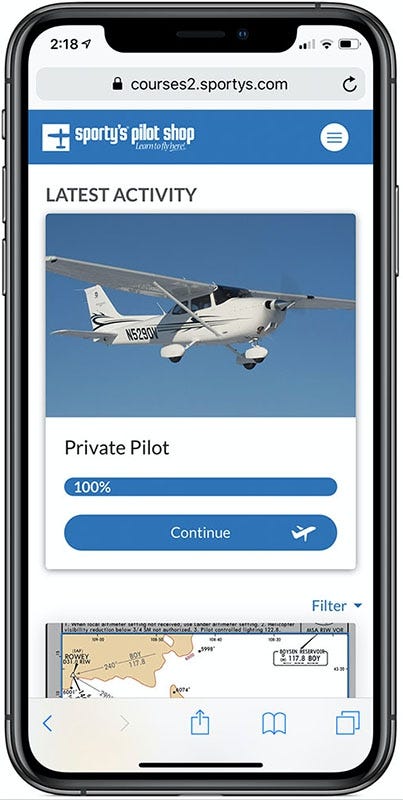
Sporty’s Pilot Training app is a powerful tool for training on the go, but sometimes you can’t beat a web browser. With that in mind, we’ve completely redesigned our online training portal to be simpler, faster, and mobile-friendly. It’s easy to use on all your devices, and there’s no software to download. Perfect for studying when you don’t have your iPad with you.
Lifetime Updates
Never worry about out-of-date materials or missing features with Sporty’s free lifetime updates. Simply buy the course once and you own it forever – no subscriptions and no upgrade fees required. Every time you log in to the online training portal or open up the Pilot Training app, you’ll have access to the latest video segments, test question updates, and training features. It’s an incredible value: for the price of one flight lesson, you’ll save thousands of dollars over your flying career.
A good home study course is one of the best investments you can make as a student pilot (or a rusty pilot). While your flight lessons will form the core of your training, there’s a lot of work to be done in between trips to the airport. Sure, you’ll need something to help you prepare for the FAA Knowledge Test, but the benefits of a course go far beyond that. It will also help you save a significant amount of time and money by preparing for each lesson at home. Most importantly, you’ll be a safer, more well-rounded pilot after you earn your certificate.
More Information
Sporty’s 2020 Learn to Fly Course is available for $249, which includes all platforms with sync and those lifetime updates.
To try the course, check out the free online demo or download the Pilot Training app for iOS and Android.
You can also learn more in this video demo:
Video: pulling Gs with the Thunderbirds
/in Fun Flying Videos/by studentpltnewsFlying a jet is fun; flying with the US Air Force Thunderbirds is a once-in-a-lifetime thrill. In this new video, you can ride along with AOPA editor and longtime flight instructor Dave Hirschman as he tears through the sky at over 9 Gs. He admits he only has two goals: “Stay conscious, and don’t hurl.”
Video courtesy of AOPALive.
Preflight Like It Matters
/in Tips and technique/by studentpltnewsAre You Doing a Good Job?
As you are performing the preflight inspection, are you doing a good job? Are you using the aircraft manufacturer’s checklist or an enhanced checklist based upon the manufacturer’s checklist or relying on your memory of that first lesson with your instructor to complete the task? Are you really looking at all of the essential items or are you simply going through the motions?
Complacency during the preflight inspection can be a problem. Don’t allow yourself to get into a “it made it back from the last flight so it must be okay” mentality. You do not want to just go through the motions. You really do need to take a look at the airplane and its components during your inspection.
The manufacturer checklist will generally not get modified when additional or replacement equipment gets installed on the airplane. This is where an enhanced checklist may be appropriate. Ensure that your checklist addresses procedural changes that any new or replacement equipment may require.
Another place that checklist enhancements may be appropriate is when the manufacturer’s checklist just doesn’t seem to flow well with your airplane. Enhancing the order of the checklist items can sometimes make it work better. Just don’t forget to include all of the appropriate items to check.
Speaking of flows, some instructors will teach their students to preflight the airplane as a flow. This is fine but it should be backed up with a checklist to ensure that no critical details are missed.
It is also a good idea to review your preflight process on occasion with a trusted flight instructor. You might be missing something inadvertently or misunderstanding something that your instructor can clarify.
Preflight like it matters, because it does.
They Won’t Fix It Anyway
There have been times in my past that I have heard students or other flight instructors proclaim that there is no use bringing a preflight finding to maintenance or to management because they won’t fix it anyway. If you are at a flight school that truly has this attitude, pack up your stuff and find a new flight school.
It is not unusual for maintenance or management personnel to defer the immediate repair of a non-airworthiness item. Just ensure that the requirements of §91.213 Inoperative instruments and equipment have been met so that you are legal to fly the airplane. If you are not comfortable with the deferral or you believe that it truly is an airworthiness item, exercise your authority as pilot in command and do not fly the airplane in that condition. If that means that you do not fly that day, always remember that it is better to be on the ground wishing that you were in the air than to be in the air, wishing that you were on the ground.
Legally deferred maintenance items should be tracked by the flight school or operator of the aircraft and they should be repaired at an appropriate time. If tracked deferrals just disappear from the list and are never repaired, this would be another time to find a new flight school.
Advanced Preflight after Maintenance
From the article: Advanced Preflights go above and beyond the normal preflight checklist. Create your checklist by reviewing the maintenance history of the aircraft, and once you have that information, develop your additional items checklist. Once you have made this list, you can use it in all future preflight inspections. Find and review all aircraft records, including receipts, work orders, FAA Form 337s (Major Repair and Alteration forms) and approval for return to service tags (8130-3 Forms). Find any Supplemental Type Certificate (STC) data, including information on items no longer installed on the aircraft.
They also included some additional tips in the article:
Your safety, and the safety of those who fly with you, depends on your vigilance. Check, ask questions, and recheck. Your life may depend on it!
The article contains a link to an FAA FAASTeam Fact Sheet on Advanced Preflight After Maintenance. Unfortunately, the link in the article appears to be going to an older version that no longer exists at the moment. An updated version of this Fact Sheet is available from the FAA Fact Sheets website.
Don’t allow a complacent preflight after maintenance to make you a LOC accident statistic!
Fly Safe
Your preflight of the airplane, along with your preflight planning and decision making are the first steps in helping to ensure that you are a safety conscious pilot. Flying is not without risks but a good pilot will work to mitigate the risks to improve his or her chances of a successful flight.
Be a good pilot and fly safe!
Friday photo: Matt Crossty private pilot checkride
/in Friday Photo/by studentpltnewsThe moment: Private pilot checkride
The pilot: Matt Crossty (right)
The place: Clermont County Airport (I69), Batavia, OH
The aircraft: C172S
The memory: From a young age my Dad taught me the joys of flying. My Dad and I would watch the flight operations at CVG. Ever since then I knew becoming a pilot was something I wanted to do. Now it’s a dream come true.
Want to share your “Friday Photo” of your solo or checkride moment? Send your photo and description (using the format above) to: [email protected]
Video: flying low over the sand dunes of Africa
/in Fun Flying Videos/by studentpltnewsDuring training, it’s easy to get bogged down in the mechanics of flying: weight and balance calculations, flight plan forms, emergency checklists. This stunning video shows the restorative power of flying just for the sake of flying. It’s all about freedom, stunning African vistas, sharing an experience with friends, and the unique places only an airplane can take you. As JP says, “I hate being a pilot, but I love flying.”
Video courtesy of the_candourist.
My 4-day airline trip offers routine and adventure
/in Career/by studentpltnewsAuthor Alan Nguyen is a Sporty’s Academy flight instructor and first officer at a regional air carrier on the Bombardier Regional Jet series of aircraft. Please enjoy this latest installment of this multi-part series taking you inside the life of an airline pilot. Ed.
It’s time to go to “work”!
Many people have asked me, “do airline crews get to skip security?” The answer is no, but we do have our own expedited screening process. Most airlines are enrolled in the “Known Crewmember” program, which allows the Transportation Security Administration to identify and confirm air carrier crewmembers and expedite the screening process – making it much less of a hassle than the standard security protocol followed for passengers.
Upon arriving at the gate, the gate agent verifies my identification on the flight release and I head down the jet bridge to greet the crew – the captain and two flight attendants. After introducing ourselves, we always begin with a crew briefing. The briefing gets everyone on the same page and it includes items such as weather, the airplane, emergency and security related procedures. Everyone has different roles and responsibilites during the preflight phase. The captain is usually ensuring the aircraft and flight is legal for dispatch as well as checking the aircraft systems and functions. The flight attendants are completing their cabin checks and ensuring the aircraft is legal inside the cabin. They are also responsible for the boarding process. As the first officer, my tasks consist of completing a preflight walk-around inspection (yes, this important task continues in the airline world), obtaining the weather (ATIS) and clearance. Following these tasks, I’ll program the airplane flight management system, radios, and flight control panel.
We run our flight deck flows and checklists, review our flight release, aircraft logbook, complete our departure briefing, receive our final passenger and bag count, and send the data to our Aircraft Communications Addressing and Reporting System (ACARS) to obtain our takeoff data. The boarding door is closed and it’s time to go fly!
The en route phase is pretty straight forward and similar to flying a cross country in a Cessna 172, only a lot faster, higher, and more Standard Instrument Departures (SIDs) and Standard Terminal Arrival Procedures (STARs). The workload is divided with one pilot flying and the other pilot is monitoring and this is decided on the ground prior to departure. The pilot monitoring is responsible for the radios, communicating with the flight attendants, and obtaining the weather and landing data at the destination and we’ll reverse roles on the flight deck for subsequent legs.
In a jet, you are capable of flying above most weather, but there are days where you have to work diligently to get to your destination safely. On the ground, the captain and I review the weather and coordinate with our dispatcher to get a new route ahead of time if able. Otherwise, we try to coordinate with ATC in the air and find routes that other airliners that have flown ahead for the best possible route. We also utilize our on-board weather radar to safely navigate thunderstorms. Every day is different which is one of the many elements I love about my job, just like my days during primary training. Some days it’s clear and calm while other days bring the challenges of heavy precipitation, gusting winds or turbulence and sometimes all three.
Upon landing, we taxi in and park at our assigned gate. I perform a postflight walk-around – just as important as the preflight so that you can identify items that may need attention when it’s most convenient to have them addressed. This is similar, in process, to the preflight, and this time I am making sure the aircraft wasn’t damaged during the en route or taxi phase as we arrive. Sometimes we have a sit (or rest), which means we stay at the airport for an hour or two awaiting the arrival of the next inbound airplane. During this time, the crew will usually go find something to eat and discuss ideas on what to do on the overnight to pass time.
Once the next airplane arrives, we repeat the process, but this time we are headed off to our overnight city, Fort Walton Beach, Florida! If the overnight stay is long enough, we usually find local attractions or new restaurants to experience. Arriving at Fort Walton Beach, we hand off the airplane to the outbound crew and inform them of weather en route and any information about the airplane regarding its behavior and tendencies, or if there’s any maintenance items required. After boarding the hotel shuttle, we’re off to unwind and anxiously await the next day’s adventure!