Common Reasons Checkrides May End in a Discontinuance (Not a Failure)
|
Getting your Trinity Audio player ready...
|
Once a checkride (practical test) has begun, there are three possible outcomes. The first is a successful outcome that results in a new temporary airman certificate: passing. The one everyone tries to avoid is a disapproval, meaning the applicant has failed and will need to return for additional training and a retest. There is one other option that doesn’t get talked about as much: the Letter of Discontinuance.
Under 14 CFR § 61.43, either the examiner or the applicant may discontinue a practical test due to inclement weather, aircraft airworthiness issues, or any other safety-of-flight concern. A discontinuance is not a failure. It does not go on your record as a bust. The examiner issues a Letter of Discontinuance that credits the areas of operation already completed satisfactorily. You then have 60 calendar days to finish the remaining portions of the test, subject to other expiration dates and eligibility requirements, such as those associated with a knowledge test report or Part 141 graduation certificate.
Examiners see these situations regularly. The three categories above account for the large majority of actual discontinuances once the test has started. Pre-test cancellations for paperwork, endorsements, or experience shortfalls are far more common overall, but those are different events. They prevent the test from beginning rather than interrupting one that is already underway.
So let’s talk about a few of the things that might cause a test to pause partway through and not be completed when it’s initially scheduled, even though it’s already begun.
Weather

A good gut check here for everyone is to ask themselves, “Would I normally go flying today?”
Weather is the single most frequent cause of discontinuances once the oral portion of the test is finished and the flight portion is about to begin (or has begun). Gusty crosswinds that exceed the aircraft’s demonstrated capability or the applicant’s personal minimums, lower-than-forecast ceilings or reduced visibility, building turbulence, or storm activity that was not fully appreciated in the morning briefing can all stop the flight.
Sometimes the reasons are even less predictable. A disabled aircraft on a runway, an unexpected airport closure due to an emergency, or even a pop-up TFR might be something that comes up between the time the test begins and when it’s expected to be finished.
The regulations and the Airman Certification Standards do not give the examiner the role of weather briefer or risk manager for the applicant. After a successful oral, the typical exchange is something like: “You’ve met the standard on the ground portion. How does the weather look for the flight?” The decision is the applicant’s. Many examiners will offer a brief weather discussion and then step back. If the conditions would make it difficult or impossible to meet the ACS tolerances (especially on landings, short-field work, or instrument approaches), the correct call is usually to stop.
Applicants sometimes push forward because they are already there, the oral went well, and they don’t want to reschedule. That pressure is understandable, but it is also exactly the kind of decision-making the practical test is meant to evaluate. Proceeding into conditions in which you would not normally launch solo, or in which you know the airplane will be difficult to control within standards, can lead to either a discontinuance later or an unsatisfactory performance that could have been avoided. Turbulence that makes altitude control difficult, or a crosswind that forces repeated go-arounds beyond the point where a landing can be completed safely, are classic examples.
A good gut check here for everyone is to ask themselves, “Would I normally go flying today?”
If the answer is no, it’s probably not the day to take your checkride. It might be time to exercise the option of a discontinuance.
Instrument applicants face similar issues with ceilings and visibility for the required approaches, or with icing and convective activity that turns out to be more severe than forecast. In all cases, a Letter of Discontinuance preserves credit for the oral portion (and any flight tasks already completed satisfactorily) and gives the applicant a 60-day window to finish under better conditions.
Aircraft Mechanical and Airworthiness Problems
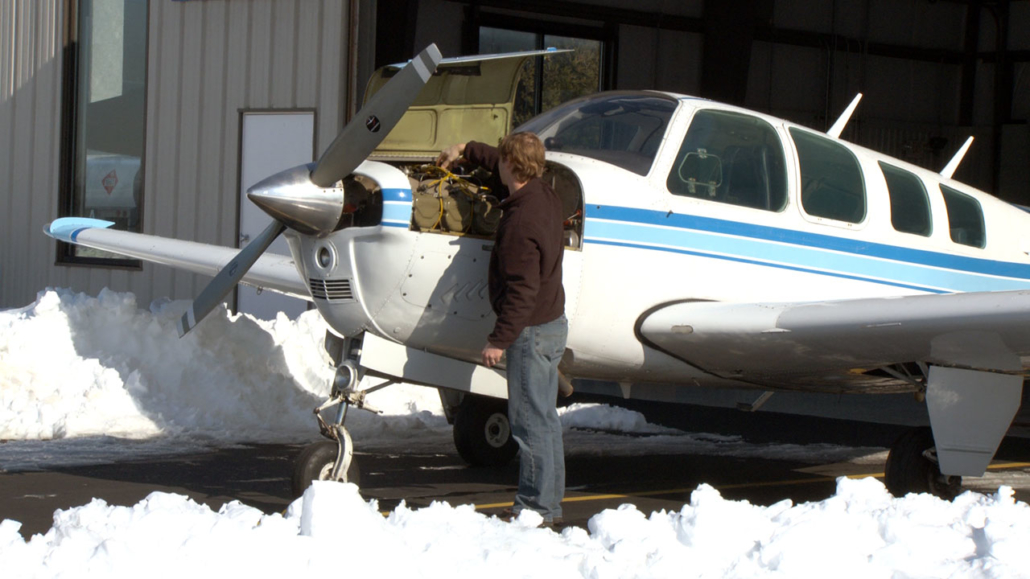
Mechanical issues discovered during the preflight, engine run-up, or in flight are another common reason for a discontinuance. A magneto drop that fails the run-up, a rough-running engine, an inoperative navigation or communication radio required for the test, a landing light that fails at night, or a more serious problem such as a cracked cylinder or fuel-system anomaly can all end the flight portion.
It might not even be a maintenance issue that you discover yourself. It could be one that is brought to your attention while you’re conducting the ground portion of the test. Imagine an airplane out on another lesson with another instructor that develops a problem. That instructor might come to you and say the airplane you were going to use for your checkride is now down for maintenance.
Examiners treat these as airworthiness and safety-of-flight matters. If the aircraft is not airworthy or develops a problem that prevents safe continuation of the required tasks, the test stops. The applicant receives credit for what has already been completed satisfactorily. In many cases, the problem is discovered before takeoff; in others, it appears after the flight has started (for example, an engine that runs rough on the climb or an intermittent radio failure on an instrument approach).
The practical difference between a discontinuance and a disapproval here comes down to the circumstances and the applicant’s performance. If the applicant recognizes a problem, announces it, and makes a sound decision to discontinue before demonstrating unsatisfactory performance, a Letter of Discontinuance is generally appropriate. Continuing with a known problem, particularly when it compromises safety or results in unsatisfactory performance, can have a different outcome.
Imagine a scenario where, during the flight, a pilot notices the oil temperature climbing and potentially the cylinder head temperature increasing. The pilot who simply says, “Let’s keep flying,” isn’t taking cues from the airplane or paying attention to the fact that its systems are warning of a problem. Choosing to divert and return to the airport to manage a potentially developing emergency would be a much better decision and could result in a discontinuance.
Good aeronautical decision-making includes calling the issue early.
Aircraft preparation is the controllable factor. Make sure inspections are current, required documents are on board, and a thorough preflight is completed to help identify any maintenance issues that could make the operation unsafe or leave you operating an unairworthy aircraft.
When something does develop, either before or during the flight, treating it as a safety issue rather than a test obstacle is the correct response. Proper management of maintenance issues is a reason for a discontinuance. Mismanagement or ignoring them can lead to a disapproval.
Illness, Fatigue, and Other Physiological Issues
The third major category is the applicant (or, less often, the examiner) becoming unable to continue safely for physiological reasons. This includes illness, significant fatigue, the onset of motion sickness, or any other condition that impairs performance or decision-making. 14 CFR § 61.53 prohibits acting as pilot in command when a medical deficiency is present; the practical test does not create an exception.
Sometimes things happen. I’m aware of cases where an applicant or an examiner has fallen on the ice and hurt themselves, an aircraft in which carbon monoxide became a concern during a flight, and numerous other unexpected issues related to medical concerns. If any of these come up, it’s time to consider a discontinuance.
Examiners will almost always discontinue immediately if they themselves become ill. Applicants sometimes hesitate because they don’t want to “waste” the oral portion or the examiner’s time. The better action is to speak up as soon as symptoms appear. Extreme anxiety that is clearly impairing performance can fall into the same category if it is addressed before the performance itself becomes unsatisfactory. The key is timing: once a task has been flown outside standards, the outcome may be a disapproval rather than a discontinuance, regardless of how the applicant feels.
IMSAFE is not just a preflight checklist item. It remains relevant throughout the day. A long oral that runs later than expected, combined with heat, dehydration, or residual nerves, can leave an applicant less sharp for the flight portion. Calling a discontinuance in that situation is viewed by most examiners as responsible pilot judgment, not a lack of commitment.
Airspace or ATC Limitations
Depending on where the checkride is taking place, airspace or ATC limitations may also be a factor. Last year, I was conducting a private pilot checkride at an airport that had one of its runways closed for an emergency fire practice drill. Another airplane then arrived with an emergency situation, while the airport was also handling multiple IFR departures. We were trying to finish a private pilot checkride and working through some extra traffic patterns to get it done. After our second landing, ATC advised us that they were unable to accommodate any further traffic pattern work at that time. We were simply boxed out of finishing all of the required tasks at that airport. So we returned to the parking area where the airplane was based and finished the checkride another day.
In rare cases, things like temporary flight restrictions may pop up, or emergencies may preclude a pilot from completing the work in the airspace available. Sometimes ATC is simply too busy to accommodate requests such as instrument approaches. It may mean planning a better time to conduct a checkride that better coordinates with busy ATC sector schedules.
What Happens Next
If a Letter of Discontinuance is needed, the next steps are pretty simple. The examiner essentially hits the pause button on the practical test and returns any materials to the applicant that they might need, such as a copy of an FAA knowledge test report. The examiner issues a Letter of Discontinuance that gives the applicant credit for the areas of the test that have been completed satisfactorily. It also identifies the areas that remain to be completed, providing clarity for the applicant and any other examiner who may be asked to help finish the test.
That’s an important factor: once a Letter of Discontinuance has been issued, the test does not have to be completed by the same examiner. Any other authorized examiner could finish the test for the applicant. That’s one of the main reasons the remaining areas are documented on the letter.
I recently had to do this myself when I took a fall and tore a tendon in my arm, making me unable to finish a couple of tests because I needed surgery. Fortunately, I worked well with a couple of other examiners who helped finish the tests for those applicants. They didn’t have to retake the whole test; they just had to finish the areas that I was unfortunately unable to complete while my arm was healing over a few weeks.
A Letter of Discontinuance preserves credit for previously passed areas for up to 60 calendar days. After that time, if the applicant has not completed the test, they will have to repeat the entire practical test. However, during that period, it’s important to remember that the applicant must still meet all eligibility requirements for the practical test. This means that applicable endorsements, flight experience requirements, graduation certificates for Part 141 programs, knowledge test results, and FAA medical requirements, for example, must still be satisfied when the applicant returns to continue the test.
Fees for completing a discontinued test vary by examiner. Some charge nothing for the continuation, some charge a reduced fee for the remaining portion, and others charge the full fee again. It is worth clarifying the policy in advance. If you’re stopping your checkride partway through and receiving a discontinuance, ask the examiner what, if anything, will be charged when you return to finish the test.
Poll Question
Practical Advice
Treat the possibility of a discontinuance as part of normal risk management rather than as a failure mode. Know your personal minimums before the day of the test and be willing to apply them. Have the aircraft thoroughly prepared and its maintenance status verified. Use the IMSAFE checklist honestly. If conditions change or a problem appears, announce it early and clearly. Examiners generally respect the pilot who says, “I’m not comfortable continuing in these conditions” or “This airplane is not ready for the rest of the flight” far more than the pilot who presses ahead and then fails a task for reasons that could have been avoided.
If you find yourself partway through a practical test and have to use a discontinuance, don’t feel bad about it. It’s one of the options available on a practical test for a reason. Sometimes things are outside of our control as pilots and beyond our ability to plan for. We’re looking to see pilots make good decisions about whether or not they’re going to fly, even on checkride day.
A Letter of Discontinuance is simply a pause. The work already done counts, the remaining tasks are limited, and the 60-day window is usually workable. The pilots who treat weather, mechanical, and physiological issues as legitimate reasons to stop, rather than obstacles to be forced through, are the ones who finish the test safely and with the credit they earned.

A NAFI Master Flight Instructor and 2023 Michigan FAA Safety Team Representative of the Year, Jason has over 30 years of flying experience and two decades as a flight instructor. He was named 2016 Michigan CFI of the Year and has served as Executive Director of the National Association of Flight Instructors. His service includes national committees such as the FAA’s Runway Safety Council, the General Aviation Joint Steering Committee, and the TSA Aviation Safety Advisory Council.
In addition to examiner duties, Jason works with aviation associations and companies as a consultant and writer, focusing on pilot training, testing, and safety. He holds undergraduate degrees in Human Resource Management and International and Comparative Politics, plus a master’s degree in Development Administration from Western Michigan University. Originally from Michigan’s Upper Peninsula, he is an avid outdoorsman who enjoys scuba diving, skiing, hunting, fishing, mountain biking, and golfing.
- Common Reasons Checkrides May End in a Discontinuance (Not a Failure) - November 16, 2026
- From the DPE: Just do what the regulation says! - October 19, 2026
- Using a Block Clearance for Maneuvers Practice [or Some Checkrides] - September 14, 2026

Leave a Reply
Want to join the discussion?Feel free to contribute!