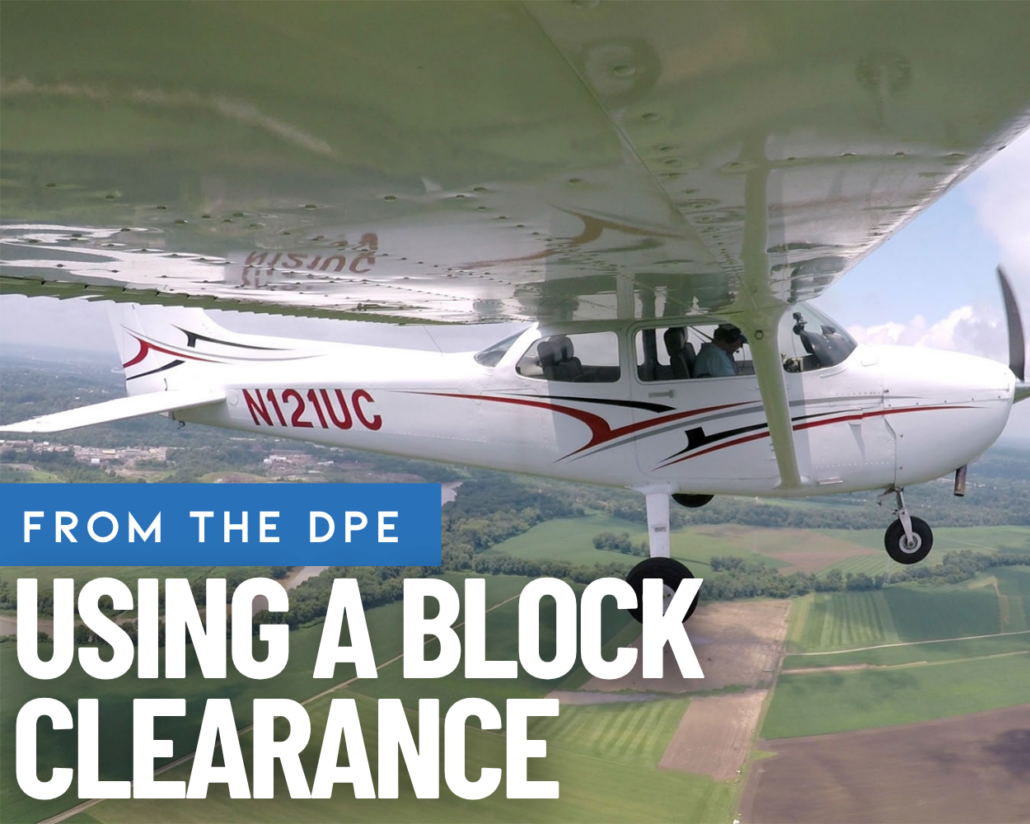
Using a Block Clearance for Maneuvers Practice [or Some Checkrides]
|
Getting your Trinity Audio player ready...
|
You start your commercial checkride and the forecast is great. High overcast or scattered to broken clouds at 10,000-12,000 feet, visibility 10+, winds light. But by the time your ground portion is done, those clouds have formed lower. Scattered at 2,500, tops 3,500.
You aren’t going to be able to do all your required maneuvers and maintain cloud clearances with that. So does that mean your checkride is going to be discontinued? Maybe, but there might be another option, too—if you know how to do it and do it correctly.
For instrument-rated pilots, especially commercial students and applicants who are IFR current, this doesn’t have to kill the flight. A block clearance (sometimes called a maneuvering block or area clearance) from ATC can turn a challenging-to-get-done maneuvers VFR day into productive training, or let you get that checkride done.
This type of clearance gives you a defined chunk of airspace where ATC provides IFR separation services, letting you maneuver legally even when you can’t maintain standard VFR cloud clearances. It’s not a magic wand, and it comes with real risks and limitations, but when used properly, it keeps the training or a practical test moving forward.
Understanding the Block Clearance
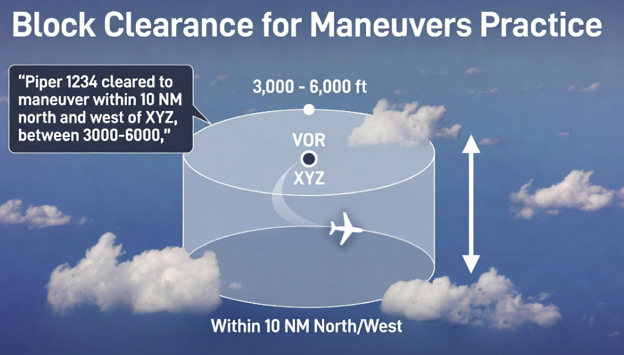 A block clearance is an IFR clearance that assigns you a geographic area and an altitude block within which you can maneuver freely. A typical example sounds like: “Piper 1234, cleared to maneuver within 10 NM north and west of XYZ VOR, between 3,000 and 6,000 feet.” ATC “cleans” that volume of airspace for you by separating other IFR traffic. You’re operating on an IFR clearance inside that block, so you’re not bound by VFR cloud-clearance requirements while inside it.
This is different from a standard IFR cruise clearance or VFR-on-top. A maneuvering block is more localized and tied to a fix or waypoint with lateral limits. It’s perfect for staying in a practice area without wandering into busy routes or uncontrolled airspace issues.
You must be on an IFR flight plan or pick up an IFR clearance (a pop-up is possible in many places). Once cleared into the block, you can climb, descend, turn, and perform maneuvers within the lateral and vertical boundaries. Then you report leaving the block or request termination when done. ATC may vector you or amend the clearance for traffic, but in light to moderate traffic, these blocks often work smoothly for 30-60 minutes or more.
Who Should Use This Technique?
To use this, you have to be an instrument-rated pilot who is legally current. Commercial pilot applicants (ASEL or AMEL) who hold a current instrument rating and are instrument current get the most value. Why? Because they already meet the knowledge and currency requirements to operate under IFR. Commercial maneuvers such as steep turns, slow flight, stalls, emergency descents, chandelles, lazy eights, etc., can be practiced under the IFR umbrella when VFR conditions are “good enough but not perfect.”
Private pilot students can technically do it if the CFI is instrument current and rated, acting as PIC and handling the IFR responsibilities. But it’s less effective for them. PPL applicants aren’t instrument rated, so the flight becomes more about the CFI managing the clearance while the student focuses on basic maneuvers.
Benefits: Turning Marginal Days into Productive Flights
The biggest benefit is continuity. A few pesky clouds that would force you to abort or limit practice to one or two maneuvers now become background noise. You stay in the area, maintain positive control, and knock out required tasks. This is most effectively used on those days when there are big, puffy clouds that offer nice, big blue open gaps, but gaps that wouldn’t give you quite enough spacing to maintain the 2,000 feet of lateral distance from them if you started doing maneuvers.
Commercial pilot maneuvers require demonstrating proficiency in a variety of maneuvers, at various altitudes. Scattered clouds at 4,000-5,000 can make slow flight, accelerated stalls, stalls, and single-engine maneuvers such as Vmc demonstrations impossible under strict VFR. With a block from, say, 3,500 to 7,500, you can set up at 6,000, do your slow flight, recover, descend for stalls, and spiral down as needed—all while staying legal.

Best Maneuvers for Block Clearances
Not every maneuver is ideal here. The technique shines for those that benefit from altitude flexibility and aren’t heavily dependent on a perfect visual horizon at lower levels.
Emergency Descents and Steep Spiraling Descents: These are perfect. You can start at the top of the block (e.g., 6,000), configure for a rapid descent, and spiral down through scattered layers while maintaining visual references where possible. The block protects you vertically so you don’t bust cloud clearances on the way down. Practice clearing turns, engine cooling, and passenger considerations just as you would on a checkride.
Slow Flight and Stalls: Set up at a higher altitude within the block where you have room to recover. Scattered clouds might obscure the horizon at 3,000, but at 5,500 you might find better visibility. Practice power-on/power-off stalls, accelerated stalls, and recovery to slow flight. The extra vertical room reduces the stress of staying clear of clouds during recovery.
Chandelles, Lazy Eights, and Eights on Pylons: Visual maneuvers like these require good horizon references. They’re doable if clouds are truly scattered, but expect challenges (more on that below). Use the block to climb above minor layers for setup.
Challenges: Horizon, Visibility, and Workload
Don’t kid yourself—this isn’t as straightforward as pure VFR. Scattered clouds create visual challenges, especially for maneuvers that rely on a clear horizon.
Horizon Viewing: Puffy cumulus can hide the natural horizon, making pitch and bank judgments trickier. Steep turns might feel disorienting if you lose the horizon on one side. Climb above the layer if the block allows.
Visibility Management: You must maintain visual reference to the surface or at least enough visibility to avoid clouds improperly. Even under an IFR clearance in VMC, good airmanship demands that you don’t blunder into IMC unintentionally.
Workload: The pilot (or CFI) must monitor the IFR clearance, respond to ATC, watch for traffic (TCAS or visual lookout), and fly the maneuver. This is higher workload than pure VFR. For students, it can be overwhelming at first. Start with simple climbs and descents in the block before complex maneuvers. The CFI or safety pilot must stay ahead.
Traffic and Amendments: ATC might need the airspace back. Be ready to terminate maneuvers and get vectored or exit the block promptly. In busy areas, blocks may be shorter or harder to get.

Risks: Be Honest About Them
Flying under an IFR clearance in visual conditions with clouds around carries risks that pure VFR does not. You are responsible for see-and-avoid. ATC separates you from other IFR traffic, but VFR traffic is still out there, and clouds can hide them.
Cloud Penetration: Accidental entry into cloud is a big one. Brief strict personal minimums. If clouds start filling in, terminate the block and descend or divert.
Regulatory Gotchas: You must comply with the clearance. Deviating laterally or vertically without an amendment is a violation. On checkrides, the DPE will expect precise adherence.
Student Pressure: Just because you “can” do this doesn’t mean you “should” on lessons or a checkride. If you are going to do it, don’t have your checkride be the first time. Be familiar with the process and experienced using it first.
Always have a solid VFR exit plan. The block is a tool, not a crutch. Be ready to actually fly an approach back to your airport if the conditions get worse.
Leveraging It for Checkrides
For a commercial checkride with some pesky clouds, you might discuss the possibility of using a block clearance with your DPE in the briefing. Many examiners appreciate proactive planning. File an IFR plan to your practice area or pick up a pop-up. Once airborne, request the block: “Approach, [callsign] requests maneuvering block within 10 NM of XYZ, between 3,500 and 7,000 for commercial maneuvers practice.”
A well-coordinated block can demonstrate professionalism to the DPE. It shows you didn’t just cancel and go home; you solved the problem safely. I’ve seen applicants use this to complete maneuvers sections that looked doubtful on the ground.
But it can also be a trap that leads to failure. Many of the maneuvers you will be doing require those visual references. This tool is best used on a checkride when clouds are WIDELY scattered and just a little pesky, not a full overcast layer that you are trying to maneuver in.
If you are going to use this on the checkride, communicate your plan to the DPE so they know exactly what you’re going to be doing. They have to be comfortable with it, too.
Using a block clearance for maneuvers practice isn’t about bending rules—it’s about using the full FAA system intelligently to get quality training done safely. Scattered clouds don’t have to ground you or limit your progress toward that commercial certificate. For IFR-current pilots, it provides a legal, structured way to keep training or potentially testing moving forward.

A NAFI Master Flight Instructor and 2023 Michigan FAA Safety Team Representative of the Year, Jason has over 30 years of flying experience and two decades as a flight instructor. He was named 2016 Michigan CFI of the Year and has served as Executive Director of the National Association of Flight Instructors. His service includes national committees such as the FAA’s Runway Safety Council, the General Aviation Joint Steering Committee, and the TSA Aviation Safety Advisory Council.
In addition to examiner duties, Jason works with aviation associations and companies as a consultant and writer, focusing on pilot training, testing, and safety. He holds undergraduate degrees in Human Resource Management and International and Comparative Politics, plus a master’s degree in Development Administration from Western Michigan University. Originally from Michigan’s Upper Peninsula, he is an avid outdoorsman who enjoys scuba diving, skiing, hunting, fishing, mountain biking, and golfing.
- From the DPE: Just do what the regulation says! - October 19, 2026
- Using a Block Clearance for Maneuvers Practice [or Some Checkrides] - September 14, 2026
- Not Every ATC Landing Clearance Means the Same Thing - August 17, 2026
Leave a Reply
Want to join the discussion?Feel free to contribute!