|
Getting your Trinity Audio player ready...
|
What’s Wrong? Beech Sierra at Cottonwood
Welcome to this installment of “What’s Wrong?“, an interesting twist on aviation challenge quizzes. “What’s Wrong?” works just like a real flight: You’re in an airplane, flying (or taxiing) along and there are clues to a potential problem right there in front of you—but it’s still on you to notice them and take action before it’s too late.
Here’s how it works: You’ll watch a super-short video with a quick setup for the situation and then approximately 10 seconds of the pilot’s perspective. Something is amiss. Can you find it? We’ll give you 3-5 options at the end as what is wrong, but don’t expect much help from these options. They are worded to (perhaps) give some hints—or distractions from the important issue—but they won’t give anything away
Watch the video and see if you know what’s wrong. When you’re done, click through to the answer. Not only will you find out what’s wrong, but you’ll get at least one helpful tip, technique, or learning point to help if you ever face a situation like this in your real-world flying.
Watch the Scenario
What do you think is wrong?
Show Explanation
The correct answer is 3: You missed a checklist item.
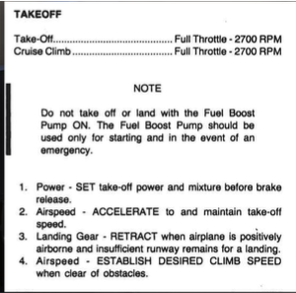 The Takeoff Checklist notes “Full Throttle – 2700 RPM.” That “2700” isn’t just your prop control being full forward. That’s the actual value you should see on the tachometer (give or take) after you apply full power. This indicates the engine is producing the expected power, which includes the prop governor maintaining the maximum allowable RPM.
If you see much less than redline RPM on the takeoff roll with a constant-speed prop, the prudent thing is to abort the takeoff. That’s unless you have the prop control in the wrong position or some other nearly instant fix available. If you see the problem after you can safely abort the takeoff, you should maximize your climb rate (or angle if there are obstacles) as you gain altitude before coming back around to land. You don’t know exactly what’s wrong, but you can diagnose that later.
This engine should reach full RPM even at much higher density altitudes than this. And while a tailwind could feel like the poor performance you see on this takeoff roll, the RPM would still read 2700. It’s unlikely this is just a faulty tach sensor because the performance on this takeoff roll is pretty lousy. That should have been a clue. (For a fixed-pitch prop, you’ll see less than redline RPM. How much less varies with the airplane and the ambient conditions.)
You did the runup checks, but did you ever look at the engine instruments again? The “REACT” checklist is a simple mnemonic that can catch a problem between applying full throttle and rotation.
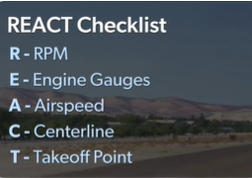 R – RPM—Do you see the expected RPM on the tachometer as the throttle moves to the takeoff position?
E – Engine Gauges—Are the engine gauges all in the green?
A – Airspeed—Is the airspeed indicator beginning to show your speed?
C – Centerline—Are you still on centerline?
T – Takeoff—Have you gotten airborne by a predetermined takeoff point?
The whole check takes only a second or two inside the cockpit for the REA. Then you’re back outside, so it’s not a heads-down problem.
Think of these as pass/fail gates you check. If any fail, abort the takeoff.
Want to receive more scenarios like this and weekly pilot’s tips right in your inbox? Sign up here.

For 19 years, Jeff ran many noteworthy aviation media projects with his own firm, Van West Communications, including magazines, books, videos and live seminars. Jeff previously served as editor-in-chief of IFR Magazine and co-editor of Aviation Consumer, and his work appears in AOPA Pilot, Flight Training Magazine, Plane and Pilot, and AVweb. He’s an experienced CFII/MEI with ratings for single- and multi-engine airplanes, seaplanes, and gliders. Jeff was the creator of the first pilot transition program for new Cirrus aircraft.
- What’s Wrong? Beech Sierra at Cottonwood - May 25, 2026
- What’s Wrong? Piper Comanche at Burlington - March 27, 2026
- What’s Wrong: A Subtle Warning at 5,500 Feet - January 26, 2026

Leave a Reply
Want to join the discussion?Feel free to contribute!