From the DPE: Collaborate on Weather Decisions for Checkride Success and Safety
|
Getting your Trinity Audio player ready...
|
As Certified Flight Instructors (CFIs), we wear many hats: teacher, mentor, evaluator, and sometimes even psychologist. Our primary mission is to shape safe, competent pilots who can handle the skies with confidence and sound judgment.
This extends to checkride day, where just preparing our students may not be enough. In some rare cases—and as an indicator that the student might not be as ready as you thought—you may have to step in to stop them from proceeding with the scheduled event for the sake of their likelihood of success, or worse, their safety.
The “Desire to Get It Done”: How Eagerness Clouds Judgment
The infamous “desire to get it done” is a psychological trap every pilot falls into at some point, but students are particularly vulnerable. After months of training, the checkride looms as the gateway to freedom—solo cross-countries, carrying passengers, or advancing to the next rating. This eagerness can distort risk assessment.
Psychologically, it’s rooted in confirmation bias: students fixate on favorable forecast elements (e.g., “The TAF shows improvement by noon”) while downplaying negatives (e.g., “But there’s a SIGMET for turbulence”). Loss aversion plays a role too—they’d rather risk a marginal day than “lose” the slot and wait weeks for another.
Real-world examples abound. I recall a student who insisted on a private pilot checkride despite gusty winds forecast at 25–30 knots. “I’ve practiced in worse,” he said. But during the test, a wind shear event led to a very rough landing, and I had to step in as the DPE to save it. No, this isn’t a pass.
The question could be asked here: Did the student fail the maneuver? Or did they really fail well before that moment—when they decided to fly in weather conditions outside their personal minimums and beyond their realistic ability to safely perform the required maneuvers for the practical test?
Had the CFI been more engaged, they could have vetoed the student’s plan to proceed with the test, regardless of the pressure that day.
We try to teach personal minimums and hope our students have internalized them, but sometimes the pressures of the moment override sound decision-making.
Encourage students to set conservative weather criteria early—say, no checkrides with winds over 20 knots, 15 knots of crosswind, or ceilings below 4,000 feet (depending on the maneuvers required for the practical test). Review these during training and adjust them based on experience.
Doing this ahead of time gives students parameters to apply on checkride day, making them more likely to stay within them.
Knowing the Plan: Why CFIs Must Track Practical Test Schedules
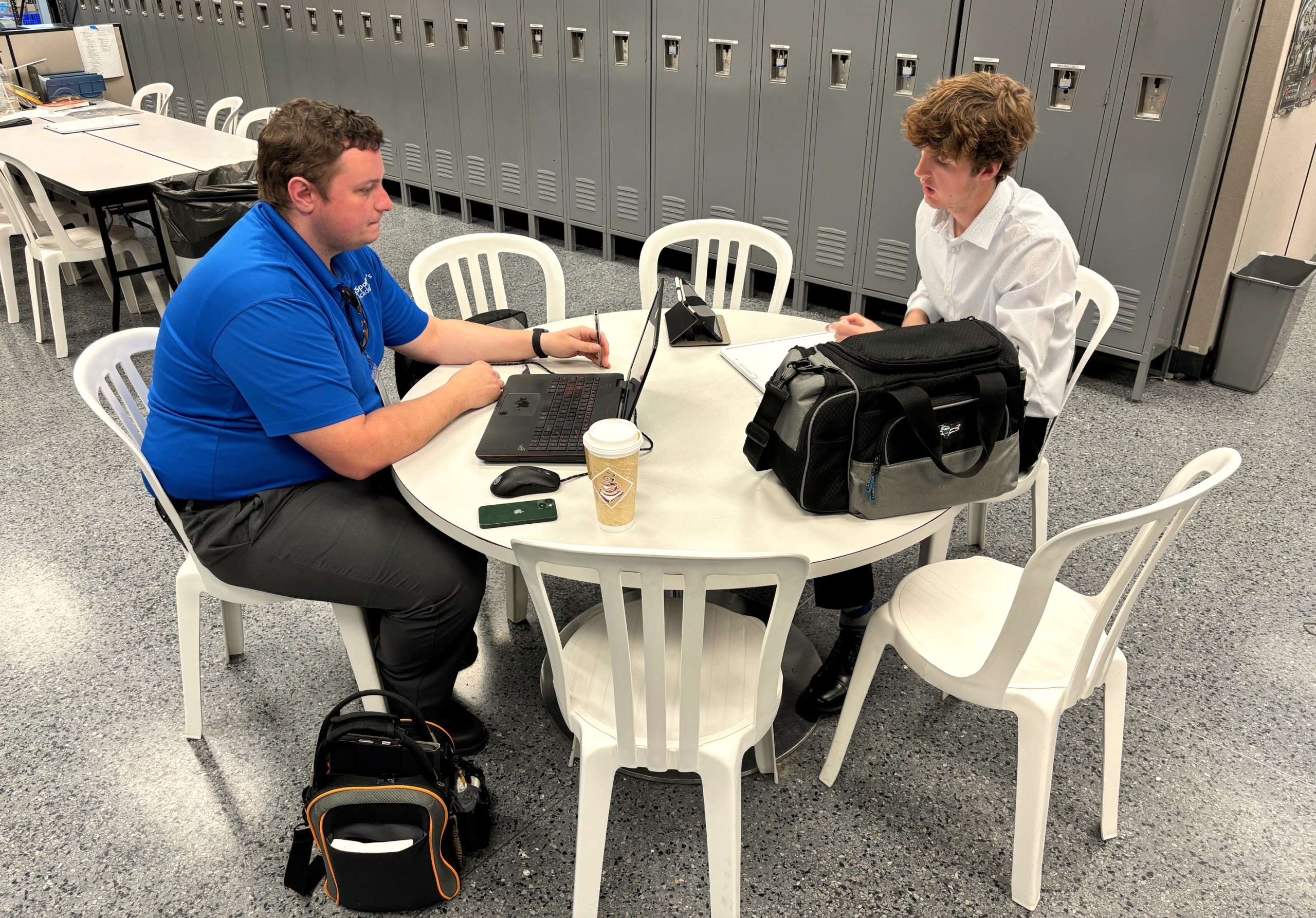
One of the most overlooked aspects of CFI responsibility is monitoring when students intend to take their practical tests. The FAA requires us to endorse students for the checkride, but that endorsement doesn’t end our involvement. In fact, it’s just the beginning. You need to know the exact date, time, and location well in advance.
It’s amazing how many times I’ve had CFIs who didn’t know when their students were actually taking a checkride and hadn’t spoken with them the night before or the day of the scheduled test—especially if there were questions about the weather.
This becomes even more important when the student will be traveling to a DPE at another airport, sometimes a significant distance away. That adds layers of complexity: fuel planning, airspace navigation, and, most critically, weather assessment. If you’re not aware of the plan, you can’t provide that final layer of oversight.
Weather Decisions: More Than Just Passing the Test
Weather is the great equalizer in aviation. It doesn’t care about your logbook hours or enthusiasm; it demands respect. For practical tests, students must demonstrate proficiency in weather interpretation and decision-making—but ironically, their own checkride day can test this skill in real time.
Remember, part of the test is their decision-making ability. The choice of whether the weather conditions are suitable to conduct the test and complete all required maneuvers is itself a demonstration of aeronautical judgment.
In a worst-case scenario, a student makes a terrible weather decision before the test even begins—trying to fly through weather beyond their capabilities or their aircraft’s limitations. Hopefully not with catastrophic consequences.
Safety extends beyond the test itself. If flying to the DPE, en route weather must be factored in. A 50-mile flight in VMC may be fine—but add low-level wind shear or convective activity, and it becomes hazardous. Post-test, elation or disappointment can impair judgment. Fatigue sets in, and a marginal return flight might seem acceptable.
The CFI as the Last Check Valve: Safeguarding Against Risk
In the chain of safety, you’re the final barrier. Students may not see the risks—they’re focused on the prize. But with your experience, you can identify red flags others miss.
Act as the check valve by:
-
Requiring pre-test reviews: Mandate a meeting 24–48 hours before the checkride to review weather, aircraft status, and personal readiness.
-
Simulating scenarios: Incorporate weather decision drills into lessons. Use apps to pull real forecasts and debate go/no-go calls.
-
Encouraging contingencies: Always plan for Plan B. Discuss alternate dates, ground transportation if weather deteriorates, or using alternate airports if conditions are better elsewhere.
-
Documenting discussions: Log these conversations in the student’s record. It protects you legally and reinforces accountability.
-
Postponing without judgment: Frame delays positively: “This ensures you’re at your best and safest.” Share stories of successful reschedules to normalize it.
Remember, FAR 61.43 requires practical tests to be conducted under conditions conducive to safe flight. If you suspect otherwise, withhold or withdraw the endorsement. It’s tough, but it’s our duty.
A Recent Example
Why do I write this now?
Let’s go with story time from a recent practical test.
It started with a text from a fellow DPE who had a commercial single-engine initial test scheduled at an airport where the weather was already deteriorating.
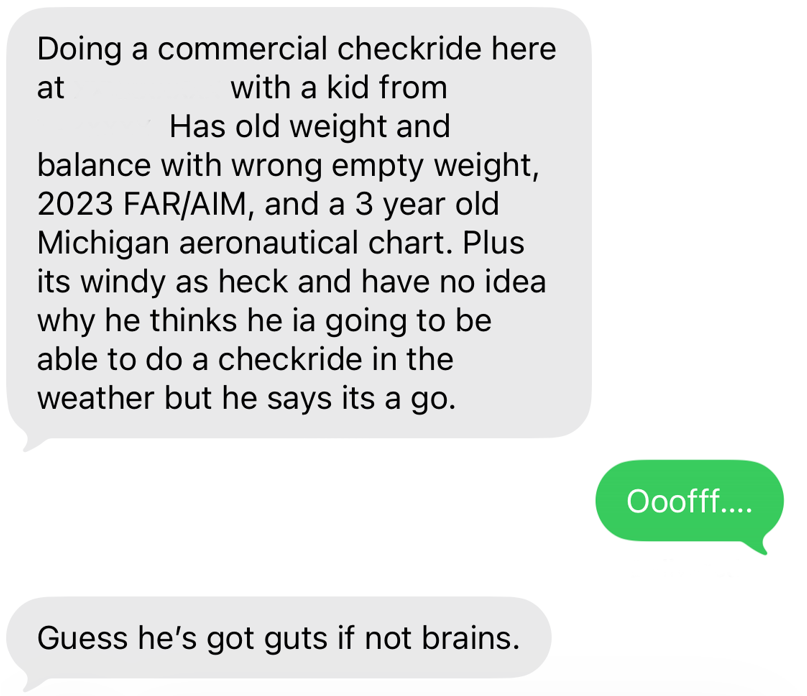
That got me curious that morning. Was this applicant really going through with the test?
A quick look at the METARs should have told anyone that the test wasn’t going to happen that day. There were GALE warnings on the Great Lakes. The METARs showed winds ramping up and ceilings declining.
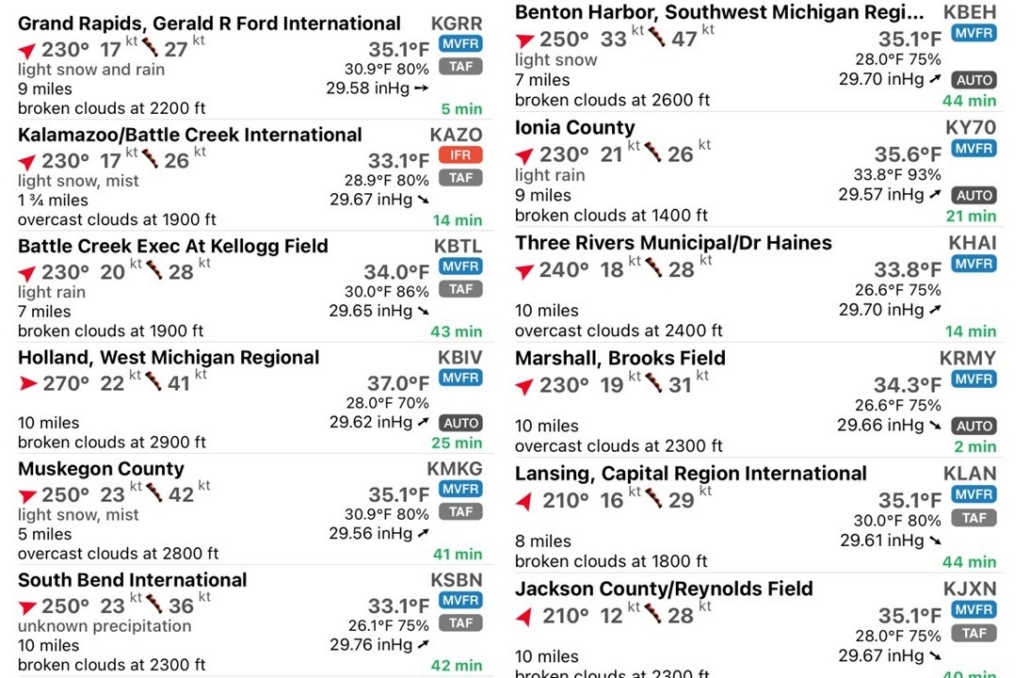
The applicant had flown to the destination airport the night before when the weather was better. Unfortunately, he hadn’t taken the time to seriously evaluate what the weather would do the next day—or how he would get home after a test in the forecast conditions.
The DPE tried to be helpful, hinting to the applicant, “Maybe today isn’t the best day to do this…” before they even started.
But the applicant persisted, saying it would be fine. Decision-making skills were already in question.
The ground portion didn’t last long, which was unsurprising given the judgment already demonstrated. A disapproval was issued for multiple ACS-based deficiencies.
At that point, the DPE tried to convince the applicant to borrow the airport’s courtesy car. They offered to help put the airplane in a hangar to keep it protected and warm. The airport manager was in full agreement. The entire team was trying to help the applicant make a good decision and avoid flying home in worsening weather.
But determined to fly the Cessna 150 home into whatever weather lay ahead, he launched.
While the applicant was preflighting, the DPE tried to reach the CFI to see if a call might influence the applicant’s decision. The CFI wasn’t available or responsive.
As DPEs, we can’t detain someone. We can’t physically stop them from flying. We can only try to influence them as best we can. But the applicant wasn’t hearing it.
After he launched, the other DPE called me. We were both sincerely concerned for his safety along the intended route of flight.
Radar showed he was headed toward deteriorating conditions—super strong winds, freezing rain, and descending ceilings.
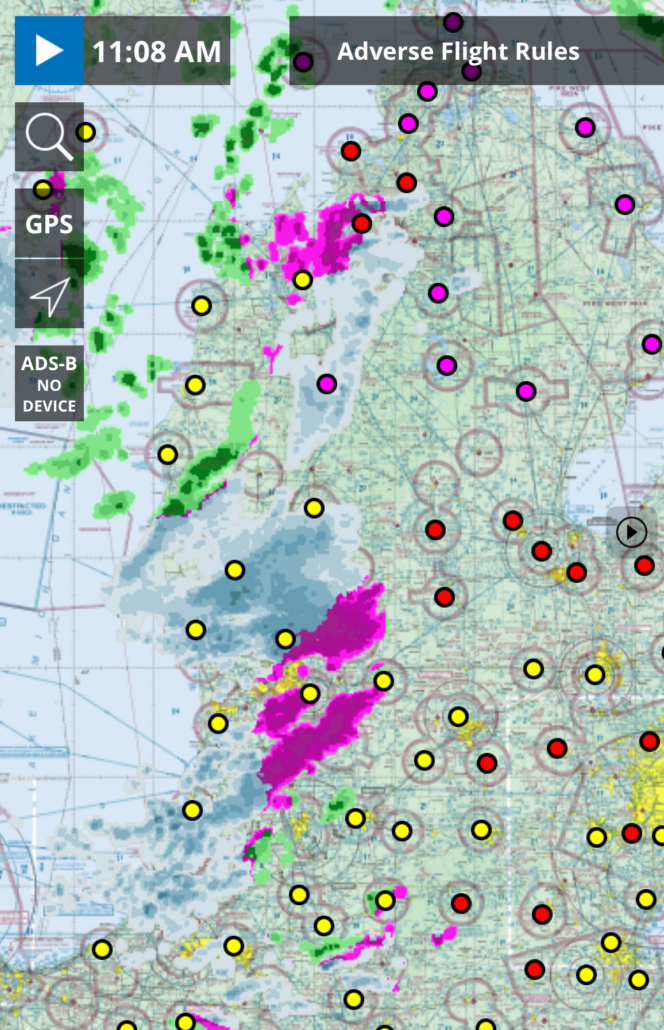
We had the uncomfortable feeling that we were watching an accident chain unfold in real time.
Then the ADS-B track stopped.
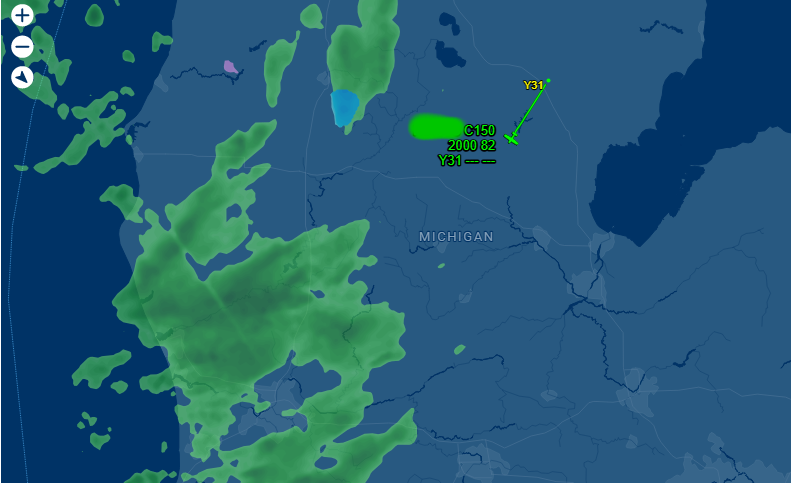
We waited, hoping he had diverted—not fallen out of the sky while icing up a 150 in a determined effort to “get home.”
The good news: he did divert. He landed at another airport—only about 21 miles from his departure point—after scud running to get in and avoiding even worse conditions ahead.
The next few days brought extreme winds and a major snowstorm in Michigan. I have no idea whether the aircraft made it into a hangar. What I do know is this: he didn’t die that day.
Thankfully.
Reading this, it’s easy to say, “I would never do that,” or “My students would never do that.” But we must remain engaged—with each other and especially with our students—as they feel the pressure of getting a checkride done.
This applies to all flying and the pressures we face to complete flights. But those habits are built at the earliest levels of training.
So CFIs, help ensure applicants don’t arrive at DPEs with major judgment issues already evident. And if you’re a student reading this, think critically and make decisions that won’t force your instructor to become the last check valve on your safety.
Let’s recommit to deep engagement with our students. Know their practical test plans inside and out. Guide their weather decisions with wisdom. Counter the “desire to get it done” with reasoned caution.
By doing so, we ensure they pass not just the test—but emerge as safe aviators.
The skies can be unforgiving. Sometimes, as a CFI, you have to be that last check valve.

A NAFI Master Flight Instructor and 2023 Michigan FAA Safety Team Representative of the Year, Jason has over 30 years of flying experience and two decades as a flight instructor. He was named 2016 Michigan CFI of the Year and has served as Executive Director of the National Association of Flight Instructors. His service includes national committees such as the FAA’s Runway Safety Council, the General Aviation Joint Steering Committee, and the TSA Aviation Safety Advisory Council.
In addition to examiner duties, Jason works with aviation associations and companies as a consultant and writer, focusing on pilot training, testing, and safety. He holds undergraduate degrees in Human Resource Management and International and Comparative Politics, plus a master’s degree in Development Administration from Western Michigan University. Originally from Michigan’s Upper Peninsula, he is an avid outdoorsman who enjoys scuba diving, skiing, hunting, fishing, mountain biking, and golfing.
- From the DPE: Collaborate on Weather Decisions for Checkride Success and Safety - February 16, 2026
- The Solo Cross-Country Requirement Every Student Pilot and CFI Must Know - January 19, 2026
- From the DPE: Teaching the Importance of Knowing the Audio Panel - December 15, 2025

Leave a Reply
Want to join the discussion?Feel free to contribute!