
VFR Challenge: MOA or Marathon—Enter Now for a Chance to Win a Flight Simulator
|
Getting your Trinity Audio player ready...
|
The VFR Mastery Series from PilotWorkshops is an innovative online training program designed to enhance the skills and decision-making abilities of pilots flying VFR. It offers real-world scenarios that challenge pilots to think critically and apply their aeronautical knowledge to make safe and informed decisions during flight.
In this sample scenario, MOA or Marathon, you’re in the cockpit with a VFR pilot flying with his son to a weekend baseball tournament in Wisconsin. En route, an active MOA sits directly on the planned course, and ATC appears reluctant to allow non-participating VFR traffic through the hot MOA. Going around would add significant time and distance—enough to question whether flying still makes sense—while going direct raises airspace, communication, and risk-management considerations. The scenario challenges pilots to weigh efficiency, compliance, and real-world pressure while making a time-sensitive decision in the air.
Step 1: Watch the VFR Mastery Scenario
Step 2: Make your choice
Now make your choice, and see what other pilots would choose.
Step 3: Learn from an expert then enter for a chance to win a home flight sim
In the expert response video below, instructor Steve Tupper walks through how he would handle this MOA dilemma, drawing on his experience as a flight instructor and professional aviator. He breaks down the practical considerations behind each option and explains how to balance efficiency, safety, and communication. And when the video wraps up, you’ll have the opportunity to enter for a chance to win a fully equipped, wide-screen home flight simulator from XForcePC and Sporty’s—a perfect way to build and maintain your flying skills at home.
Win a home flight simulator valued at more than $3,500!
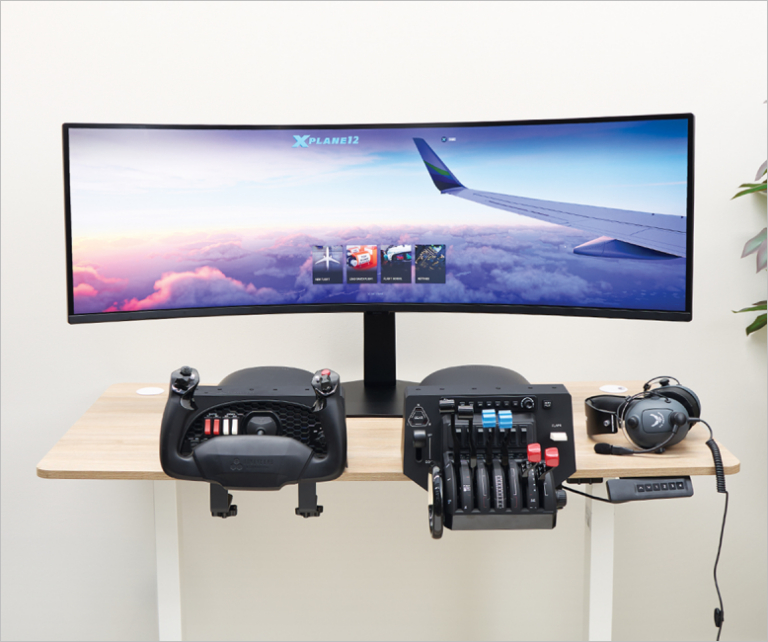 Be sure to click the “enter to win” button at the conclusion of the expert video (above) for a chance to win this fully equipped, wide-screen monitor flight simulator from XForcePC and Sporty’s. The sim includes:
- High-performance PC optimized for flight simulation
- X-Plane version 12 pre-installed
- Compatible with Microsoft Flight Simulator
- 49″ Super Ultra-Wide Monitor
- Honeycomb Alpha Flight Simulator Yoke
- Honeycomb Bravo Throttle Quadrant
- Thrustmaster Flight Rudder Pedals
- Flight Simulator Headset from Thrustmaster
- Video quick-start guide for setting up and using this sim
The simulator drawing ends December 31, 2025.
VFR Mastery from PilotWorkshop
Subscribers to the VFR Mastery Series can continue to an audio recording of a roundtable discussion where five additional experts offer their opinions on the best choice. And it’s rare that all the experts agree (although one might agree with your choice). The highlights from these roundtables are compiled for each scenario. Subscribers can continue the discussion among themselves along with the experts in a dedicated forum and have access to quizzes as well as all previous scenarios.
If you are interested in learning more or subcribing to VFR Mastery Series from PilotWorkshops, click the banner below and begin your free trial.


- Upcoming Webinar: Instrument Approach Decision-Making—IFR Mastery Live - February 21, 2026
- February 2026 Test Question Update from Sporty’s - February 20, 2026
- Behind the Scenes of Sporty’s New Seaplane Rating Course – On the Water Flying Podcast - February 13, 2026

Thank you for this helpful example of how to navigate through active MOA’s. There are none in my immediate area, but I’ve always been a little intimidated by them. Flight training didn’t really cover them, except for reading the FARs, which doesn’t really let a person wrap their head around all the implications of what we are able to do in a scenario like this. It’s reassuring to hear from an actual military pilot of what to expect, as long as we stay fairly low and monitor ATC we should be fine.
Not sure I agree with conclusion given pilots relatively low experience flying
I chose number four but the other option is to fly under 500 ft AGL ;)
Good information. There is not an enter to win button at end of video when viewing on iPhone.
If you view it on a desktop computer, the enter to win button shows up on the screen.
This analysis makes a number of assumptions that could prove to be unwise. We ought not to assume that the airspace between 3,000 and 10,000 isn’t in active use within the MOA – why might the military have asked for that block of airspace if they didn’t intend to use it? The Air Force’s Risk Management process – something I used on Active Duty and that I like to implement in my own flying – calls for mitigating risk as much as possible. Option 2 stops short of this by accepting some unmitigated risks based on assumption. As a CFI, I liked options 4 and 5 much better.
Great scenario, as a CFII, MEI, retired military F-16 Evaluator Pilot, former Baron intercept pilot on both sides (F-16 and the GA aircraft) and now airline pilot, I disagree with the recommendation/conclusion. Option 4 is far better from a whole picture. Points to consider:
1. Purpose – the flying will take longer than driving. Period. So the flight is for fun, not time savings as the scenario hints. That changes the flavor and also helps inform discretion as part of the ADM, not pushing to legal limits because you want to do something – especially as a 4 month minted private pilot with maybe 100 hours.
2. Flying through the NOTAM’d active MOA is absolutely an option and legal, but not always wise.
3. As presented, the airspace between the MTRs and 10K where he has done intercepts, is still fully active – nothing prevents military pilots from using it, but the commenter assumes his intercepts are the only type of training that happen in a MOA (not true). In fact, the entire MOA is a low level (500′) option – not just the MTRs. The MTRs can be active without the MOA being active – they are not mutually required. Basic Fighter Maneuvers (BFM) can happen down to 5K’ AGL, but intercepts to the low level environment can happen across the entire MOA with limited training rules in the airspace presented as “reasonably clear.” These intercepts often start from 20K MSL and ramp down to 2-4K AGL in 2-3 minutes depending on the scenario.
4. When an unknown or unplanned aircraft enters the airspace, military pilots must knock-it-off and address the unplanned intrusion. They can do that several ways, but it interrupts their training. Occasionally, if the VFR aircraft is right in the middle of their scenario, you may get an intercept investigating the aircraft at ATC’s request or their own confirmation for safety (type of aircraft, direction, altitude, etc…). Ultimately, these are your tax dollars you just wasted by interrupting their training and proficiency.
5. By far, the best choice is #4 – get airborne, inquire the status of the MOA with ATC. A MOA can be NOTAM’d active all day but only used for certain times. Ask ATC when they expect the MOA to go active (different than the scenario presents); ATC knows when to expect the military aircraft from their scheduled takeoff times and usually has a good idea when they will go active. Then make an informed choice on whether to go through the MOA based on the information provided. ATC may proactively deconflict the GA and military aircraft to both player’s satisfaction (time and conditions permitting) and tell the GA aircraft the military aircraft are only planning on using 5K AGL and above for their training (see BFM above), which would then be positive, proactive deconfliction for all.
6. I disagree with the assertion that ATC directions must be complied with in this scenario. ATC has no jurisdiction to direct in this scenario unless going through restricted or other airspace (like a TFR). A simple MOA does not give them jurisdiction to give vectors. They may offer guidance, but they are not required vectors as in controlled airspace.
I believe option 4 is by far the best choice. Going straight through the MOA is a “legal” and valid option, but it is not sound airmanship and knowing the full risks around your airplane. If saving the few minutes going around the MOA is untenable due to financial or other considerations, the better airmanship choice is to drive and remove the risk. It is already going to take longer to fly (however less “cool”), exercise wisdom when you fly.
CFII, also CAP Lt Col and Stan/Eval officer and have flown the target missions. Entirely agree with points 1-5 for all of the reasons given. Point 6 might be technically correct, but if anything goes amiss, the pilot is open to a violation of 14 CFR 91.13 (Careless and reckless.) In my aviation risk analyses, one of the questions I ask myself is, “What will this look like on the NTSB report?”
Go with #4. Flying will always make you “cool”, no matter how much longer it might take. And so what if you are told to go around. It would likely be the safer course or it would not be recommended and gives you more flight experience. Definately a win-win!
I agree entirely with the comments above endorsing option 4, and disagree strongly with the advice in the video. It may be “legal” to do what the video recommends, and “legal” to ignore ATC if they don’t give you what you want, but it is far from good practice to create a potential issue and increase the workload for a center controller managing an active MOA along with other traffic. And let’s remember, the purpose of the flight as laid out in the scenario is to get to a Little League baseball tournament that’s only one hour’s drive away — and apparently to “look cool” to the kids and coaches — hardly a reason to do what’s suggested in the video. There may be reasons to push ATC for their concurrence to enter an active MOA, such as an ill passenger, low fuel, or concerning weather where there are no other good options, but a 12-year old’s baseball tournament does not make my list.
As a dumb old low-time pilot with a tendency to over-emphasize safety, I’ll choose #4 over “cool” and negotiating with ATC to bring unnecessary risk into the decision-making process!
The FAA states that a MOA is non regulatory airspace.,..and the the FAA’s ATC job is to separate IFR traffic ….while going through ….If one is VFR …number one job of the PIC..is …see and avoid…..
From the FAA
. MOAs consist of airspace of defined vertical and lateral limits established for the purpose of separating certain military training activities from IFR traffic. Whenever a MOA is being used, nonparticipating IFR traffic may be cleared through a MOA if IFR separation can be provided by ATC. Otherwise, ATC will reroute or restrict nonparticipating IFR traffic.
b. Examples of activities conducted in MOAs include, but are not limited to: air combat tactics, air intercepts, aerobatics, formation training, and low-altitude tactics. Military pilots flying in an active MOA are exempted from the provisions of 14 CFR Section 91.303(c) and (d) which prohibits aerobatic flight within Class D and Class E surface areas, and within Federal airways. Additionally, the Department of Defense has been issued an authorization to operate aircraft at indicated airspeeds in excess of 250 knots below 10,000 feet MSL within active MOAs.
c. Pilots operating under VFR should exercise extreme caution while flying within a MOA when military activity is being conducted. The activity status (active/inactive) of MOAs may change frequently. Therefore, pilots should contact any FSS within 100 miles of the area to obtain accurate real-time information concerning the MOA hours of operation. Prior to entering an active MOA, pilots should contact the controlling agency for traffic advisories.
d. MOAs are depicted on sectional, VFR Terminal Area, and Enroute Low Altitude charts.
And the word SHOULD (see above)..is not the same as MUST
Let’s assume you are flying a 1946 Champ…no radio..VFR flight rules
This is irresponsible. ATC has NO responsibility to give you separation from aircraft in a MOA–and they may not be actually talking to the military aircraft in the MOA. The military aircraft must check in, but then they do their own thing.
The controller is not going to try to separate you from aircraft the s/he is not controlling.
I am ok with asking ATC for flight following and going around the MOA if denied (option 4). Advocating going through a known active MOA and trying to convince ATC to provide you separation is poor advice. Ignoring ATC and going VFR is worse advice.
And misleading. MOAs are not formed for MTRs. An MTR might go through a MOA–or might end in a MOA. But MOAs are not activated because aircraft are flying the MTR.
Very poor advice on your part–especially to less experienced pilots. Very poor.
Vince Massimini (CFI/CFII/FAA Gold Seal/NAFI Master/Former military tactical jet pilot who saw many bug-smashers in MOAs and resisted buzzing the stupid idiots.)
Kentmorr Airpark, MD
RE:Win a home flight simulator valued at more than $3,500!
So, who won the prize?
Sam Grant, I’ve never really seen the winner’s name posted. Maybe they do elsewhere.
The conclusions and recommendations offered in this VFR Mastery scenario are extremely disturbing. The guidance reeks of an attitude which flys in the face of sound aviation decision making and risk management. I hear (read) an attitude which describes a pilot going through the motions of safe and smart flying, unless or until it becomes inconvenient. Thereafter, subject pilot does what is most convenient. The risk does not diminish just because the pilot attempts to rationalize it away.
I write as a pilot who has used MOAs from 500 feet AGL up to the Flight Levels, at speeds varying from 250 to 600+ Knots. This is routine, and happens multiple times on a single flight, usually with more than one aircraft involved. The writer’s example of a planned intercept within an MOA is perhaps the tamest of activities conducted within. More frequent are multi plane engagements that are extremely dynamic and demanding, from both a mental and physical perspective. It is routine for these pilots to use extreme rates of change in airspeed, altitude, and direction. There is absolutely no guarantee that the “hard deck” will be 5,000 AGL, and the hard deck can be inadvertently violated by the slightest miscalculation or error. That is why the MOA will often have a floor of SFC (Surface), even if the hard deck is several thousand feet above. You do not want to be in an active MOA!
As a GA pilot, I have found the FAA controllers to be extremely helpful in avoiding the dangers inherent within the MOAs. If ATC advises me that the MOA is active, they have very good reason for doing so. I heed their advice, and I implore all GA pilots to do the same.