AIM Change 1 Update Clarifies Upwind Leg at Towered Airports
|
Getting your Trinity Audio player ready...
|
Change 1 Effective August 7, 2025
A new revision to the Aeronautical Information Manual (AIM) is now in effect, and it includes an important clarification for pilots operating at towered airports. The FAA has updated paragraph 4-3-3 to realign the definition and depiction of the upwind leg with how it’s used by air traffic control (ATC) in practice.
Previously, there was a disconnect between how the AIM defined the upwind leg and how controllers applied it operationally. The new guidance clearly establishes the upwind leg as an extension of the departure leg, not a separate or parallel traffic pattern entry. This change helps resolve confusion and improves coordination between pilots and controllers.
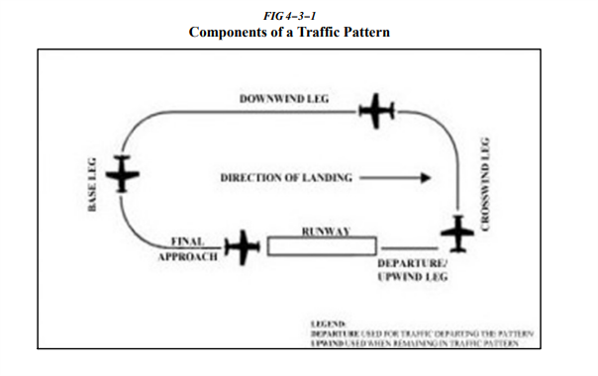 The updated Figure 4-3-1 and revised language in 4-3-2c now reflect this common usage, and the entire sequence of traffic pattern components has been reordered for greater clarity—starting logically with departure.
A flight path that begins after departure and continues straight ahead along the extended runway centerline.
Upwind leg is an extension of departure and is used when issuing control instructions for separation, spacing, or sequencing.
Change 1 also includes a variety of other updates ranging from destination signs to EFVS approaches and aviation weather products. Read the explanation of changes here.
Purchase your 2026 FAR/AIM hard copy here.

- Test Your Knowledge: Sharing Flight Expenses with Passengers - March 9, 2026
- RAA Scholarship Applications Now Open for 2026 - March 6, 2026
- How Do Your FAA Written Test Scores Stack Up in 2026? - February 27, 2026

Clear as mud. Is this only for towered airports? So what happened to the upwind/parallel leg that we had before all this confusion? Seems to me the air traffic controllers wrote this version of AIM so as not to change anything for them.
I agree with Wayne’s comments. This is the result of “scope creep”, i.e., the use of a standard terminology in a way that was not originally intended. If this is where the FAA is really going, then this new usage needs to be formalized in the Pilot Controller Glossary (or the FAA needs to quit harping on pilots and controllers about using standard terminology) and it and AC 90-66C needs to be updated so that it’s clear the usage as a departure leg extension ONLY applies to towered airfields. That, or the FAA needs to come up with something else when describing non-towered airfield patterns to remove the ambiguity.
Note that the (muddy, yes) explanation says “extension of departure” and NOT “extension of departure leg.” There is no mention of a “departure leg” as such in the excerpt provided here.
I have the AIM app and also read the link for the AIM provided and I made sure my Far AIM app on my Mac was updated and for me both still say a Parallel track.
seems like Upwind was never an a standard arrival procedure, only departure, so this change effects all use of the term? I’ve only been to one airport that uses the term upwind, and I don’t think it’s ever used in a manner that other pilots know what their intention is